Losing your erection when you change position
If your erection reliably fades when you shift position, that pattern has a name and a cause. Position-dependent ED is often a sign of venous leak, and it is treatable.
Read the articleHome / Patient resources / Article
The penile Doppler ultrasound decides whether you have a venous leak. Here is what PSV, EDV and the resistive index measure, what is normal, and what points to a leak.

If you have been told you may have a venous leak, the penile Doppler ultrasound is the test that decides it. The report is full of abbreviations and numbers. Here is what they measure, what is normal, and what points to a leak.
A medication is injected into the side of the penis to produce an erection without arousal. An ultrasound probe then measures how fast blood flows through the arteries over the next several minutes. Healthy erections need two things: strong flow in, and veins that close down to stop the blood flowing back out. The test measures both.
Anxiety in the exam room can keep the erectile muscle from relaxing fully, and an incomplete erection can mimic a leak. A good test uses a full medication dose, sometimes a second (“redosing”) injection, and measurements taken over several minutes. If the result does not fit your symptoms, it is worth repeating before acting on it.
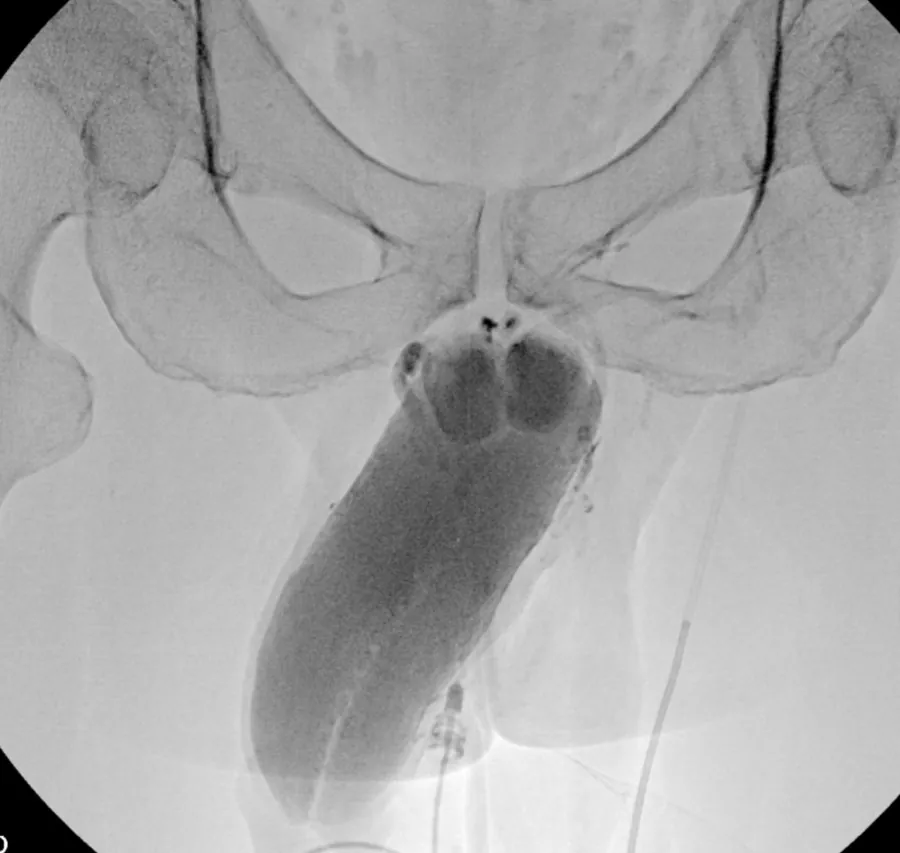
If the Doppler shows a leak, the next step is usually a cavernosogram: X-ray dye shows exactly which veins are leaking. That map is what makes venous leak embolization possible, because the leaking veins can then be closed from the inside through a needle puncture. For every option side by side, see venous leak treatment options.
Bring your Doppler report to your consultation. Dr. Golowa reviews the images and numbers himself, and will tell you if the test needs repeating before any treatment decision. Call our office at (212) 991-9991 or book an appointment.
If your erection reliably fades when you shift position, that pattern has a name and a cause. Position-dependent ED is often a sign of venous leak, and it is treatable.
Read the articleVenous leak is a cause of ED that shows up when men cannot maintain an erection because blood drains away too fast. Medication often fails. Embolization targets the cause directly.
Read the article