By Yosef Golowa, MD, FSIR · Published August 10, 2026 · 4 min read
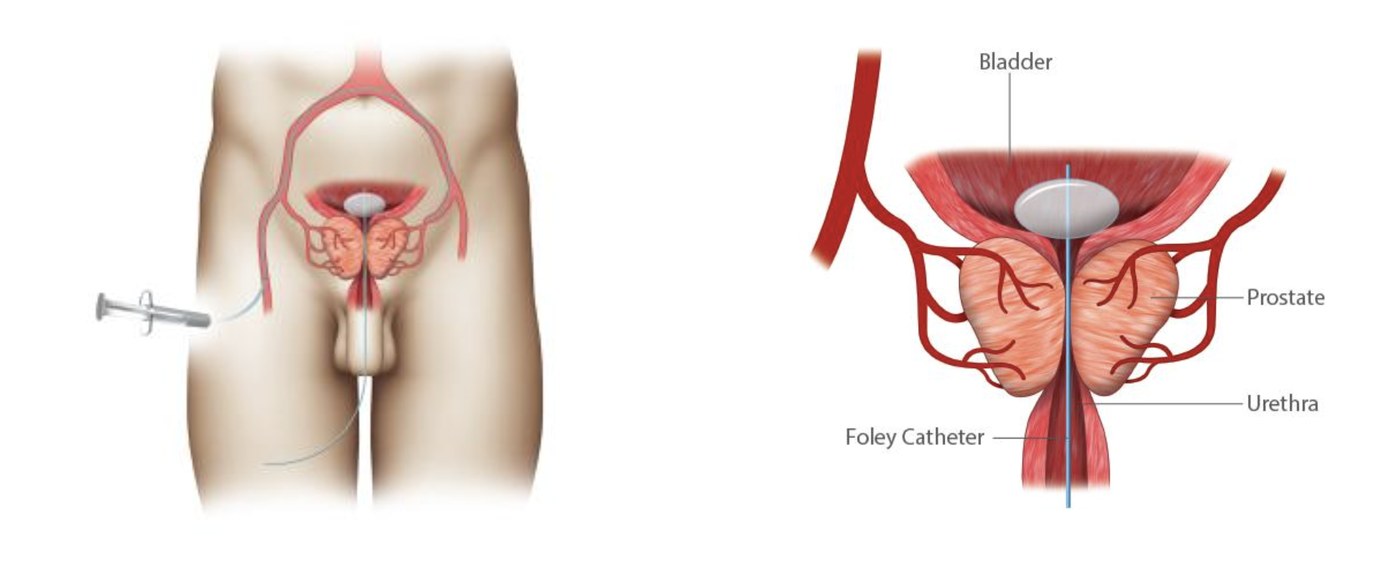
Navigating medical decisions is hard enough without conflicting claims about the best way to do a procedure. If you are looking into prostate artery embolization for an enlarged prostate, you have probably encountered a debate about how the arteries should be reached: through the wrist, called radial access, or through the groin, called femoral access.
Here is what the science actually says.
The appeal of the wrist
The transradial approach has become popular in recent years, and it does have a genuine anatomical advantage in specific patients. In some older men the pelvic arteries become extremely tortuous, looping and twisting in complex ways. In those cases, navigating a catheter downward from the wrist can occasionally give a more favorable angle into the small prostatic arteries than pushing upward from the groin.
The drawbacks of the wrist
Distance, and the tools it costs you. The wrist is a long way from the prostate. Because the target is so far from the access site, interventional radiologists are forced to use exceptionally long catheters. That makes the catheter harder to control and severely limits the selection of advanced tools, specialized wires, and microcatheters. When a case becomes difficult, there are fewer options available to solve it.
Artery thrombosis and hand symptoms. The radial artery is much smaller than the femoral artery. The same-sized catheter therefore takes up proportionally more space in the vessel, and the risk of the artery clotting off is significantly higher. Radial artery occlusion is not an abstract concern: it can cause hand pain, cramping, and reduced hand function over time.
A rare but real risk of stroke. To travel from the wrist to the pelvis, the catheter must pass through the upper chest and cross the aortic arch, directly past major vessels that feed the brain. Manipulating catheters in that area carries a small but genuine risk of dislodging plaque or forming clots.
What the literature says about stroke risk
Symptomatic strokes are rare, but silent injury appears more common than most patients realize. The MOSAIC study, a prospective multicenter Japanese study, performed MRI before and after transradial liver interventions in 57 patients. Silent brain infarction was found in 9 of them, 16.4%: small strokes causing no obvious symptoms, but indicating neurological injury. No symptomatic strokes occurred.
The study also identified what drives that risk, which matters. A prolonged catheterization time from the left subclavian artery to the descending thoracic aorta, beyond about 58 seconds, was a significant risk factor, as was a left subclavian artery angle of 50 degrees or less. When the investigators restricted the approach to favorable anatomy and adopted strict heparinization with continuous catheter flushing, the incidence fell to 2.9%.
The honest reading is that technique and patient selection matter a great deal. There are also published case reports of severe strokes after transradial access for pelvic embolization, with resulting weakness and vision loss. The risk is small, but it is not zero, and it is a risk the groin approach does not carry at all, because the catheter never crosses the vessels feeding the brain.
Why cardiology is different
You may be wondering why the wrist is the preferred route for heart procedures. Anatomy dictates the risk. When a cardiologist enters the right wrist to reach the heart, the catheter takes a short, direct path that bypasses most of the vessels feeding the brain. To reach the prostate, the catheter must travel much further, over the top of the aortic arch, crossing a vital artery supplying the brain that is not crossed at all from the groin.
Why the femoral approach remains the standard
- Proximity. The femoral artery is next door to the pelvic organs, which makes the anatomy far more straightforward to navigate.
- Control. Over a short distance, the operator has closer to one-to-one torque control of the catheter.
- The full toolkit. The femoral approach allows the use of specialized catheters, wires, and devices that are simply not made in the lengths radial access requires. In complex anatomy, that matters.
Two myths worth correcting
Myth: the wrist approach is less invasive. The access is exactly the same size. Whether the entry is radial or femoral, the hole made in the vessel and the sheath used to introduce the catheters are identical in diameter. Entering a smaller vessel with the same-sized tool is arguably more traumatic to that vessel, not less.
Myth: groin access means a longer stay. This is outdated. Femoral access once required lying flat for several hours. Modern vascular closure devices seal the artery internally, and patients can often walk within the first hour and go home just as quickly as radial patients.
The takeaway
There is no one-size-fits-all answer in medicine. In selected patients with challenging anatomy, radial access can be advantageous and can be performed safely. But the perceived convenience of the wrist has to be weighed against limited tools, the risk of hand complications, and a small but serious risk of stroke that careful technique reduces rather than eliminates. For most patients, the direct and highly controlled femoral approach remains the safest and most effective route.
To learn more about prostate artery embolization, call our office at (212) 991-9991 or book an appointment with Dr. Golowa.