By Yosef Golowa, MD, FSIR · Published March 31, 2026 · 2 min read
Knee osteoarthritis limits how freely people move and how much they enjoy their lives. Pain medication, joint injections, and physical therapy remain the mainstays, but one strategy gaining traction combines a minimally invasive procedure, genicular artery embolization, with the cornerstone of osteoarthritis management: targeted knee exercise.
Understanding the problem
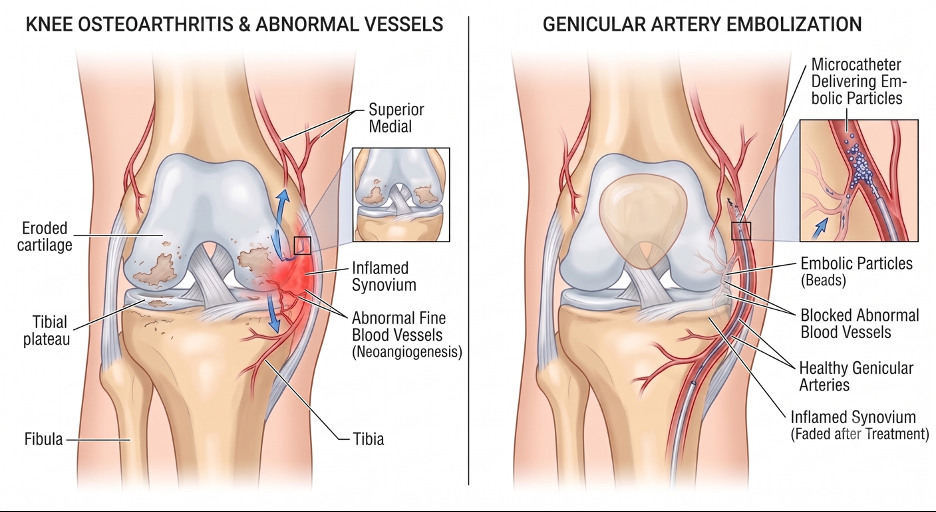
Knee osteoarthritis involves the breakdown of protective cartilage within the joint, which leads to bone rubbing against bone, and to pain, swelling, and reduced mobility. Inflammation plays a major role in the symptoms. The synovial membrane lining the joint capsule becomes inflamed, a state called synovitis, and releases inflammatory mediators into the joint space that contribute significantly to pain and stiffness.
What GAE does
Using fluoroscopic guidance, a tiny microcatheter is navigated to the small genicular arteries supplying the inflamed joint lining. A targeted injection of either an oil emulsion or tiny gel particles is delivered, blocking or reducing the excessive blood flow feeding the inflammation.
The goal is to reduce synovitis, and with it pain, improving function. GAE does not rebuild cartilage, but it addresses a major source of the symptoms and quiets the inflammatory cascade, potentially slowing progression.
Why exercise still matters
Exercise is fundamental to managing knee osteoarthritis. It can seem counterintuitive to exercise a painful joint, but the right kind of movement is what protects it.
- Strengthening. Building the muscles around the knee, the quadriceps, hamstrings, and glutes, acts as a natural brace, absorbing shock and reducing the load on the joint.
- Flexibility and range of motion. Gentle stretching maintains the knee's ability to bend and straighten, which is what stiffness takes away.
- Low-impact aerobic work. Swimming, cycling, and elliptical work improve fitness and circulation without pounding the joint.
The obstacle is obvious: pain and inflammation often make these exercises difficult or impossible to perform.
The synergy
- GAE creates a window of opportunity. By reducing inflammation-driven pain relatively quickly, it makes the knee feel substantially better.
- Exercise becomes feasible. With less pain limiting movement, patients can engage with, tolerate, and progress through a physical therapy programme.
- Exercise builds lasting resilience. Where GAE addresses the immediate inflammatory pain, exercise builds the strength, stability, and flexibility that sustain function. Stronger muscles support the joint better and improve overall mechanics.
Think of it this way: GAE helps put out the inflammatory fire. Exercise then rebuilds and reinforces the structures around the joint.
What a combined path looks like
- Assessment by both the interventional radiologist, for GAE candidacy, and a physical therapist or physician, for exercise prescription.
- The GAE procedure itself, performed as an outpatient.
- Recovery, usually rest and a gradual return to activity over a few days to weeks.
- A guided exercise programme, focused on strengthening, flexibility, and low-impact conditioning, progressed as tolerated.
To find out whether GAE is right for you, call our office at (212) 991-9991 or book an appointment with Dr. Golowa.