
GAE for Knee Pain: Is This Nonsurgical Treatment Right for You?
Chronic knee pain doesn’t have to mean either misery or surgery. Learn whether minimally invasive genicular artery embolization (GAE) is right for you.
Read the articleHome / Patient resources / Article
If you’re experiencing osteoarthritis knee pain and can’t seem to find relief, you may want to consider geniculate artery embolization (GAE). Learn how this minimally-invasive treatment can help.
Chronic knee pain affects some 25% of adults, and osteoarthritis (OA) is one of the top causes. Once these symptoms set in, they can interfere with everything from your usual daily activities to your ability to get restful sleep.
If you’re dealing with OA knee pain that won’t ease up through other treatments, consider geniculate artery embolization (GAE).
At his Midtown Manhattan practice, double board-certified radiologist Dr. Yosef Golowa provides this minimally-invasive procedure for candidates right here in our office. Learn more about genicular artery embolization.
Let’s delve into GAE, including how it helps OA and the benefits to look forward to.
Osteoarthritis of the knee causes the cartilage and surfaces of the joint to become rougher, typically from years of “wear and tear.”
Once OA sets in, your knee can’t move as smoothly as it should. Meanwhile, you may experience periodic knee pain and stiffness that worsens over time. Your knee may also appear swollen and make a creaking or crunching sound with movement.
In some cases, osteoarthritis also causes a fluid-filled lump known as a Baker’s or popliteal cyst at the back of the knee.
Factors that raise your risk for knee OA include:
This form of knee arthritis may also run in families due to a genetic factor.
Genicular artery embolization aims to slow down the progression of osteoarthritis while significantly reducing your pain. During the procedure, Dr. Golowa inserts a thin, hollow tube (catheter) into an artery in your thigh.
He then guides the tube along the artery that supplies blood to your knee’s lining, injecting gel particles. These particles reduce blood flow to those tissues, making way for less pain and inflammation.
The process takes about an hour, and you can expect noticeable results about two weeks later.
Dr. Golowa may recommend genicular artery embolization if you have advanced knee osteoarthritis and earlier treatments, such as oral medication or joint injections, no longer suffice. GAE may also be a good option if you’re not a candidate for traditional surgery.
In general, ideal GAE candidates are 40-80 years old, have no joint deformities, and have moderate to severe osteoarthritis pain. You may not qualify if you smoke, have cancer, have an infection, or seem best suited for knee replacement surgery.
To learn more about geniculate artery embolization or to get started with the care you need, call our office or book an appointment with Dr. Golowa through our website today.
Chronic knee pain doesn’t have to mean either misery or surgery. Learn whether minimally invasive genicular artery embolization (GAE) is right for you.
Read the article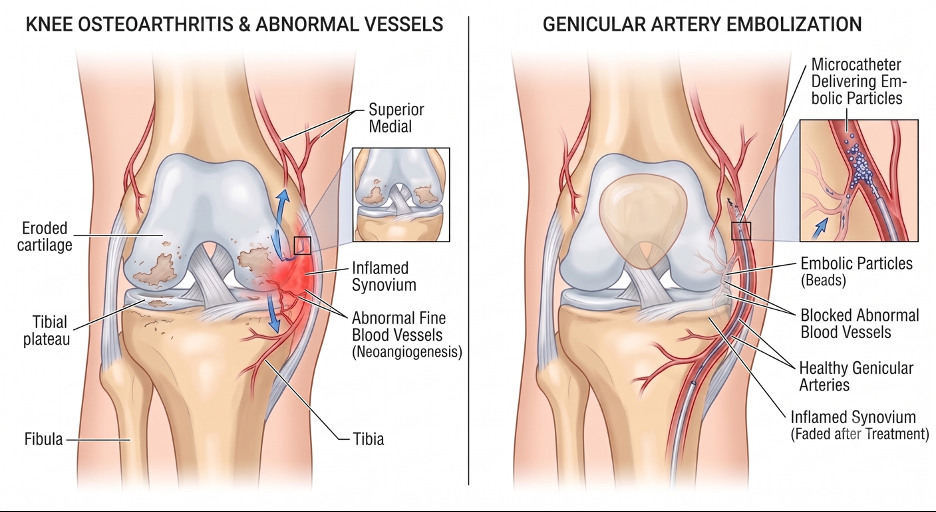
Chronic knee pain can keep you from going about your daily life with ease. Here are five common causes, plus a minimally invasive treatment that works.
Read the article