By Yosef Golowa, MD, FSIR · Published June 23, 2026 · 2 min read
A recent article in the Washington Post has cast a spotlight on a minimally invasive treatment for knee osteoarthritis that is generating significant interest and offering new hope: genicular artery embolization.
For the millions of Americans living with knee osteoarthritis, treatment has often felt like a trade-off. Lifestyle changes and physical therapy come first, but many eventually face steroid injections with diminishing returns, or the prospect of knee replacement surgery.
GAE approaches the problem differently: not by replacing the joint, but by reducing the inflammation that drives the pain. For people who have exhausted other options and are not ready for, or not eligible for, a total knee replacement, it is emerging as a way to delay major surgery and improve quality of life meaningfully in the meantime.
What the procedure involves
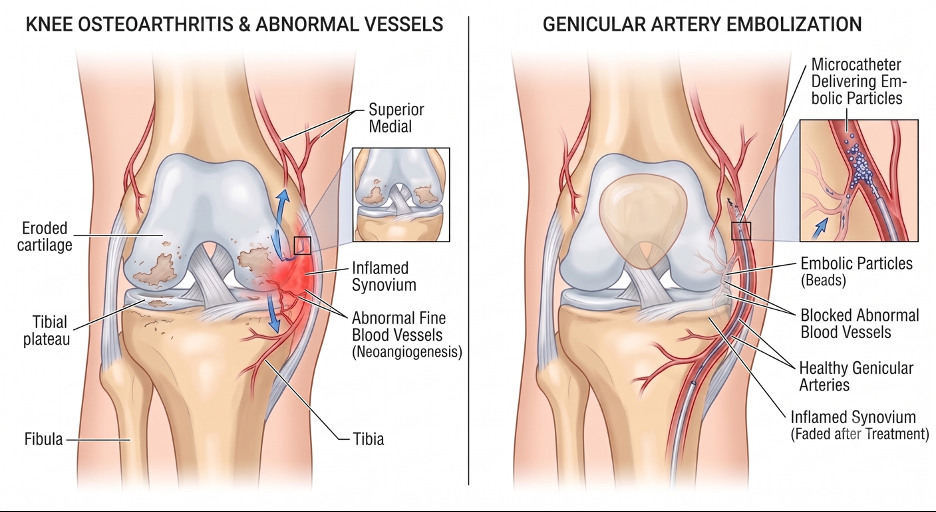
The idea is to reduce excess blood flow to the lining of the knee joint, the synovium. In an arthritic knee that lining is inflamed and carries an overgrowth of tiny abnormal blood vessels, which are a key source of the inflammatory agents causing pain and stiffness.
- A tiny entry point. A small puncture, usually in the upper thigh, is used to access an artery.
- Navigation. Using real-time X-ray imaging, a thin flexible catheter is guided through the arterial system down to the small genicular arteries supplying the knee.
- Blocking the flow. Microscopic beads or an oil emulsion are injected into those arteries, blocking the abnormal vessels in the synovium.
- Reducing inflammation. With the excess supply cut off, inflammation within the joint falls, and so does pain.
The whole procedure is performed on an outpatient basis, and recovery is quick, with many people returning to normal activities within a day or two.
Why the interest
Steroid injections give temporary relief, their effect wanes, and repeated injections carry their own risks. GAE appears to offer something more durable. Patients who have had it frequently report walking further, climbing stairs more easily, and returning to activities they had given up.
Who it suits
GAE is not a cure for osteoarthritis, because it does not repair damaged cartilage. It is a targeted treatment for the pain and inflammation. Good candidates typically:
- Have moderate to severe knee pain from osteoarthritis.
- Have not found adequate relief from physical therapy, pain relievers, or corticosteroid injections.
- Are either not ready for a total knee replacement, or are trying to delay one.
To find out whether GAE is right for you, call our office at (212) 991-9991 or book an appointment with Dr. Golowa.